How to Change Your Name After Marriage in the UK: A Step-by-Step Guide


When the confetti has settled and the thank-you cards have (almost) been sent, you may begin to wonder how to change your name after marriage.
Changing your name after marriage can feel like a lot of admin, but with the right order and a clear plan, it’s much simpler than it looks.
Whether a civil partnership or a marriage, this step-by-step guide on how to change your name after marriage in the UK covers everything – from your passport to your bank account – so you can move forward feeling organised, confident and in control.
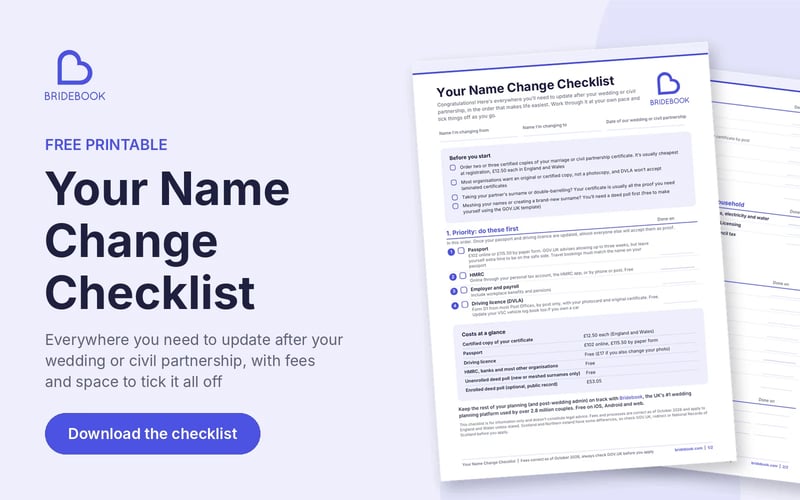
You can also download our free, printable name-change checklist to make sure you have everything ticked off.
Disclaimer: This article is for informational purposes only and does not constitute legal advice. Always seek professional legal advice for your specific situation.
Do You Have to Change Your Name After Marriage?

No, and it’s important to say that clearly.
There’s no legal requirement in the UK to change your name after getting married. You, your partner, both of you, or neither of you can decide what feels right.
Some common options include:
- Keeping your own surnames
- Taking your partner’s surname (either partner, any couple)
- Double barrelling both surnames
- Blending both names or creating a completely new surname (this may require a deed poll name change)
- Using your married name socially and professionally while keeping your original name legally, or vice versa
There’s no “right” choice – only what works for you.
How to Change Your Name After Marriage in the UK (Step-by-Step)
There’s no single legal step to change your name after marriage – your marriage or civil partnership certificate is the legal evidence, and you will need to use it to update each organisation.
If you’re not sure where to start, here’s the simplest way to approach changing your name after your wedding:
- Get your marriage or civil partnership certificate
- Update your passport (or apply before the wedding with a PD2 form)
- Notify HMRC and your employer
- Update your driving licence
- Update your bank accounts, cards and mortgage
- Work through the rest (GP, utilities, subscriptions, etc)
Following this order makes everything smoother – and avoids having to redo forms or provide extra proof later. The order you update things in can save you time, stress, and duplicate admin.
Your passport and driving licence are your core ID documents, and once they’re updated everything else, especially banks, accepts them as proof.
What Documents Do You Need to Change Your Name After Marriage?

Your marriage certificate is the key document for most name changes in the UK.
Top tip: Order two or three certified copies when you register your marriage. Many organisations require an original, not a photocopy, and having extras will speed things up. Note that certified copies are usually cheapest when ordered at the time of registration, too. You’ll pay £12.50 per certified copy in England and Wales, or £38.50 if you require a priority service.
You’ll typically need:
- Marriage certificate (original or certified copy)
- Current passport or driving licence
- Proof of address (in some cases)
How to Change Your Name on Your Passport After Marriage

This is one of the most searched steps when it comes to changing your name – and one of the most important.
To change your name on your passport after marriage, you’ll need to apply for a new passport.
You’ll need:
- Your current passport
- Your marriage certificate
- A new passport photo
- An application (online or paper)
How to apply:
- Apply online via GOV.UK (this is the fastest option)
- Or complete a paper form from the Post Office
How long does it take?
Typically, the process of applying for a new passport takes around three weeks, but it can take longer (up to 10 weeks) during busy periods.
How much does it cost?
- Standard online application: £102
- Paper form by post: £115.50
Fees are reviewed every year, so check the latest British passport fees on GOV.UK before you apply.
Do you have to change your name on your passport after marriage?
No. You can keep travelling on your current passport and carry your marriage certificate. The rule that matters is that your travel bookings match the name on your passport exactly.
Some countries may insist the details on your other travel documents match your passport, so always check before booking.
Can you change the name on your passport before the wedding?
Yes. You can apply up to three months before your ceremony using the PD2 form (passports for newlyweds and civil partners), which must be signed by the registrar or religious minister conducting the ceremony. Note that:
- The new passport is post-dated and only valid from the date of your ceremony.
- Your current passport is cancelled when you apply, so you can’t travel abroad in the meantime.
- Some countries won’t issue visas for post-dated passports – check first if your honeymoon destination needs one.
- The full passport fee applies, and some councils charge a small fee for the registrar to sign the form.
Important travel tip: You must travel to and from your destination under the name on your passport. If your honeymoon bookings are in your original name, wait until after your trip to update it. Use the PD2 route if bookings are in your new married name.
How to Change Your Name with HMRC and Your Employer

Updating HMRC ensures your tax and National Insurance records stay accurate. GOV.UK explains every option on its tell HMRC about a change to your personal details page.
How to update HMRC:
- Update your details online through your personal tax account or the HMRC app, or
- Contact HMRC directly via phone or post
Then:
- Inform your employer
- Update your payroll details
- Update workplace benefits and pensions (and your student loan company, if applicable)
This step is essential for avoiding payroll or tax issues later.
How to Change Your Name on Your Driving Licence After Marriage
This is an important step many people prioritise. Here’s how to do it:
- Pick up form D1 (‘application for a driving licence’) from most Post Offices
- Fill it in with your new name
- Post it to the DVLA with your current photocard licence and your original marriage certificate (photocopies aren’t accepted)
Note that you can’t change the name on your driving licence online – online applications are for address changes only. Here’s what else you need to know:
- Changing the name on your driving licence is free. You only need to pay if you also want to change your photo (£17) or have lost your licence (£20)
- You can still drive while you wait for your new licence
- You’ll need to update your V5C vehicle logbook too, if you own a car
- Northern Ireland has a different process – you can find out more about that through the DVA
How to Change Your Name on Your Bank Account After Marriage

Once your core documents are updated, you can move on to your finances. Most UK banks allow you to update your name:
- In branch
- By post
- Sometimes online
You’ll usually need:
- Marriage certificate
- Updated ID (passport or driving licence)
Don’t forget to update:
- Credit cards
- Savings accounts
- Loans and mortgages
Couples with joint accounts will need both account holders’ details updated (if applicable), and your mortgage lender should be told separately – they may also ask for the marriage certificate by post.
Changing Your Name After Marriage Checklist: Everywhere You Need to Update

Once the main admin is done you can focus on all the other things at your own pace. Bridebook, the UK’s #1 wedding planning platform used by over 2.8 million couples, has a free checklist to keep your admin organised, and the list below covers everywhere you’ll need to update:
Priority:
- Passport
- HMRC
- Employer
- Driving licence
Financial:
- Bank accounts
- Credit cards
- Loans/mortgage
- Insurance
- HM Land Registry and house deeds, if you own property
- Workplace and private pensions
- DWP, if you receive any benefits
Healthcare:
- GP surgery
- NHS records
- Vet, dentist and optician
Household:
- Gas, electricity and water providers
- TV licensing
- Council tax
Personal admin:
- Mobile phone contracts
- Insurance (car, home, life)
- Electoral roll
- Student finance, subscriptions and memberships
- Upcoming travel bookings and frequent flyer or loyalty schemes
- Email signature, LinkedIn and social media, if you want to update them
Top tip: Download and print our checklist so you can tick things off as you go – it makes the process feel much more manageable!
Double-barrelled, Meshed or New Surnames: Do You Need a Deed Poll?
Here’s what you need to know:
- If you are taking a partner’s surname: You’ll need the marriage certificate only
- If you are double barrelling both surnames: HM Passport Office accepts the marriage certificate. A few organisations (some banks, phone or energy providers, for example) may ask for a deed poll, so check before you start the process of changing your name with them.
- If you are meshing names or creating a brand-new surname: You will need a deed poll.
When it comes to working out which name comes first for those double-barrelling, there’s no rule – it’s completely your choice!
For those who need a deed poll to create their new surname, the most common is the unenrolled deed poll; this can be made for free using the GOV.UK template, signed in front of two witnesses, and then used straight away. It’s the quickest, most private and lowest-cost way to change your name.
An enrolled deed poll is formally registered with the Royal Courts of Justice in London and costs £53.05. It means your old name, new name, and full address are published in The Gazette (and remain visible online permanently) – you should only do this if you specifically want or need your name change to become a permanent, public record.
Changing Your Name After Marriage: FAQs
How long do I have to change my name after getting married?
There’s no time limit. You can change your name immediately after your wedding or years later.
How much does it cost to change your name after marriage in the UK?
How much it costs to change your name after marriage in the UK varies on what you choose to do with your surname and the official documents you’ll be updating.
If you’re taking your partner’s name or double barrelling, your marriage certificate – and the cost of those (£12.50 each) – is usually all the proof you need. If you are blending your surnames or creating a brand-new surname, you’ll need to pay for a deed poll, which can be free, or starts from around £14 if you use professional services to draft it for you.
It is completely free to update your name with banks, HMRC, and the DVLA, but a new adult passport will cost you £102, and this is a key document.
What are the disadvantages of not changing your name after marriage?
There are no rules that state that you must change your name after marriage, however, there may be some disadvantages if you have children.
Travelling with children who have a different surname can trigger extra questions at airport security or border control, for example, which means you may have to carry extra documents such as birth certificates.
Routine tasks – such as picking up prescriptions for a partner or child or dealing with medical forms at a GP – can also occasionally lead to requests for proof of relationship.
Can you keep using your original surname at work after changing it legally?
Yes, you can continue using your original surname professionally, particularly if you want to protect your professional reputation and client base. However, if your job requires strict vetting or government security clearance, you may be required to disclose all legal name changes.
Is the process the same after a civil partnership?
Yes, the name changing process after a civil partnership is the same as changing your name after marriage in the UK.
Is changing your name after marriage different in Scotland?
Yes, changing your name after marriage in Scotland can be slightly different to that of England and Wales. In Scotland there is no need to change your name by deed poll, even if you’re using a blended or new surname, the marriage certificate is sufficient. For everything else, the marriage certificate route works in the same way.
Admin all sorted?
It’s time to plan your honeymoon! Check out the best honeymoon destinations in the world here.
Why Trust Bridebook
Bridebook is the world’s #1 wedding planning platform, used by over 2.8 million couples. Our content is informed by real data from the Bridebook UK Wedding Report, which draws on responses from thousands of couples planning their weddings each year. Where expert input is included, contributors are named and their credentials verified. We update our articles regularly to ensure prices, statistics, and advice reflect current market conditions.
You Might Also Like
- Wedding Thank You Cards
- The Ultimate Wedding Planning Checklist
- Best Honeymoon Destinations in the World